
There is a particular problem that arrives about three days after a baby does.
The news has to go out. To the grandparents who already know, to the cousins who have been waiting, to the neighbours, to the office, to the friends who will be hurt if they hear it from someone else. And the parents, who have slept maybe four hours in two days, are the ones expected to organise it.
Something has to arrive at each house. It cannot be a plain box of mithai, because this is not an ordinary occasion. And it cannot take a week to arrange.
Quick answer: A baby announcement box is a sweet box designed to deliver the news itself — it carries a message panel and sweets in the colour of the announcement, so whoever opens it knows what has happened before anyone explains. It replaces the separate card and the separate mithai box with one thing. For an aqiqa, order three to four days ahead; for a straight announcement, a day or two is usually enough.
Why a box says it better than a message
A message on the phone gets read and scrolled past. A box gets opened, looked at, shown to whoever is in the room, and usually photographed.
That difference matters more in this particular announcement than almost any other. People remember how they found out about a birth, and for years afterwards the grandmother will mention that a box arrived. Nobody ever says they remember the WhatsApp.
There is a practical side too. A box reaches the people who are not on your group chats — older relatives, the neighbours, your father’s colleagues. Those are exactly the people who notice being left out.
What’s inside the box
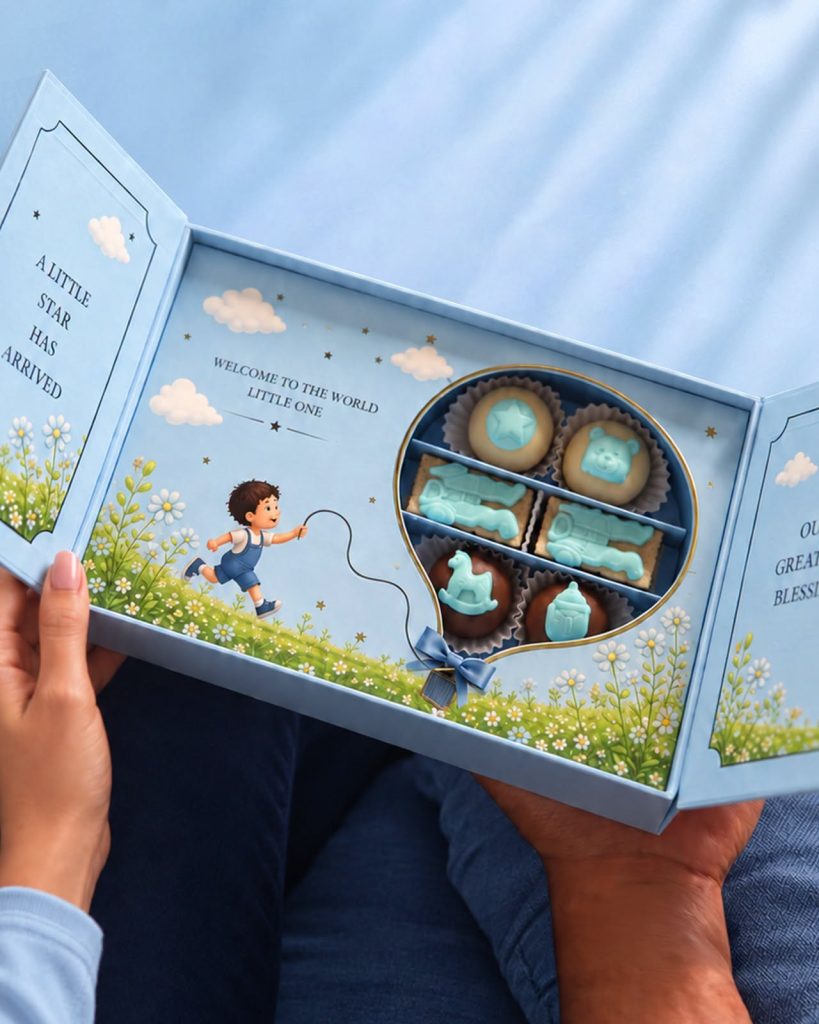
The Blissful Baby Box is built around the announcement rather than around the sweets, which is the right way round.
The lid carries the message — a little star has arrived — so the news lands before anyone eats anything. Inside, the chocolates are moulded into the shapes that belong to this occasion: a rocking horse, a feeding bottle, a teddy, a small car, a star. Each one is finished in the announcement colour, blue or pink, so the box tells you the rest of the news without a single word about it.
It is designed to be handed over, not couriered in a plain carton. The box is the gift as much as what is in it.
Boy, girl, or neither yet
The blue box and the pink box do the same job in the colour that matches the news.
Some families prefer to keep it neutral — for a first announcement to a wider circle, or where the couple would rather not lead with the baby’s gender. For those, a standard sweets gift box with a handwritten card does the same work without the colour coding.
There is no rule here. The only wrong choice is sending something that looks like an ordinary mithai order on a day that is not ordinary.
Who to send it to
Work outward in circles, and be more generous than feels necessary. Boxes are cheaper than hurt feelings.
The inner circle — both sets of grandparents, siblings, the aunt who was at the hospital. These go first and they go the same day, even if everything else waits.
The ones who will tell everyone else — every family has two or three of these. Sending to them early means the news spreads the way you want it to, rather than through a rumour.
The ones easy to forget — neighbours, your parents’ close friends, the family doctor, the house help’s family. This is where announcements usually go wrong, and where one extra box fixes it.
The office — one larger box for the whole floor works better than individual ones, and it does the job in a single trip.
Aqiqa, and how far ahead to order
Most families send the boxes alongside the aqiqa rather than before it, which usually puts it in the first or second week.
If you want boxes for a specific day, order three to four days ahead. The boxes are made up rather than pulled off a shelf, and an aqiqa order is usually a quantity rather than one or two. For a straight announcement with no fixed date, a day or two is normally enough.
For larger numbers — twenty boxes and above — it is worth a call rather than an online order, so the quantities and the delivery day can be settled properly.
If you would rather send sweets by weight alongside the boxes, a mithai gift basket works for the households where a box alone feels light.
What to send if you are the one visiting
This is the other half of the occasion, and people get it wrong constantly.
If you are visiting a new mother, bring something for her, not only for the baby. She has received a great deal of baby clothing and almost nothing that is hers. Something sweet that she can eat with one hand while holding a baby in the other is worth more than another romper.
Panjeeri is the traditional answer and it is traditional for good reason — our panjeeri guide covers why it is given to new mothers. A box of soft sweets works too, and keeps better than cake.
And if you are wondering more generally what to carry when visiting a house, our guide to what to bring when visiting someone’s home covers the wider etiquette.
Frequently asked questions
What is a baby announcement box?
A sweet box designed to deliver the news of a birth — it carries a message on the lid and sweets in the announcement colour, so the person opening it understands immediately.
What goes inside a baby announcement box?
In the Blissful Baby Box, moulded chocolates shaped as a rocking horse, a feeding bottle, a teddy, a car and a star, finished in blue or pink.
How far in advance should I order for an aqiqa?
Three to four days for a fixed date. For twenty boxes or more, call ahead rather than ordering online.
Is there a box for a baby girl as well?
Yes — the same box in pink. A neutral option is available for announcements where you would rather not lead with the colour.
What should I take when visiting a newborn?
Something for the mother, not only the baby. Panjeeri is the traditional choice; soft sweets that keep for a few days also work well.