
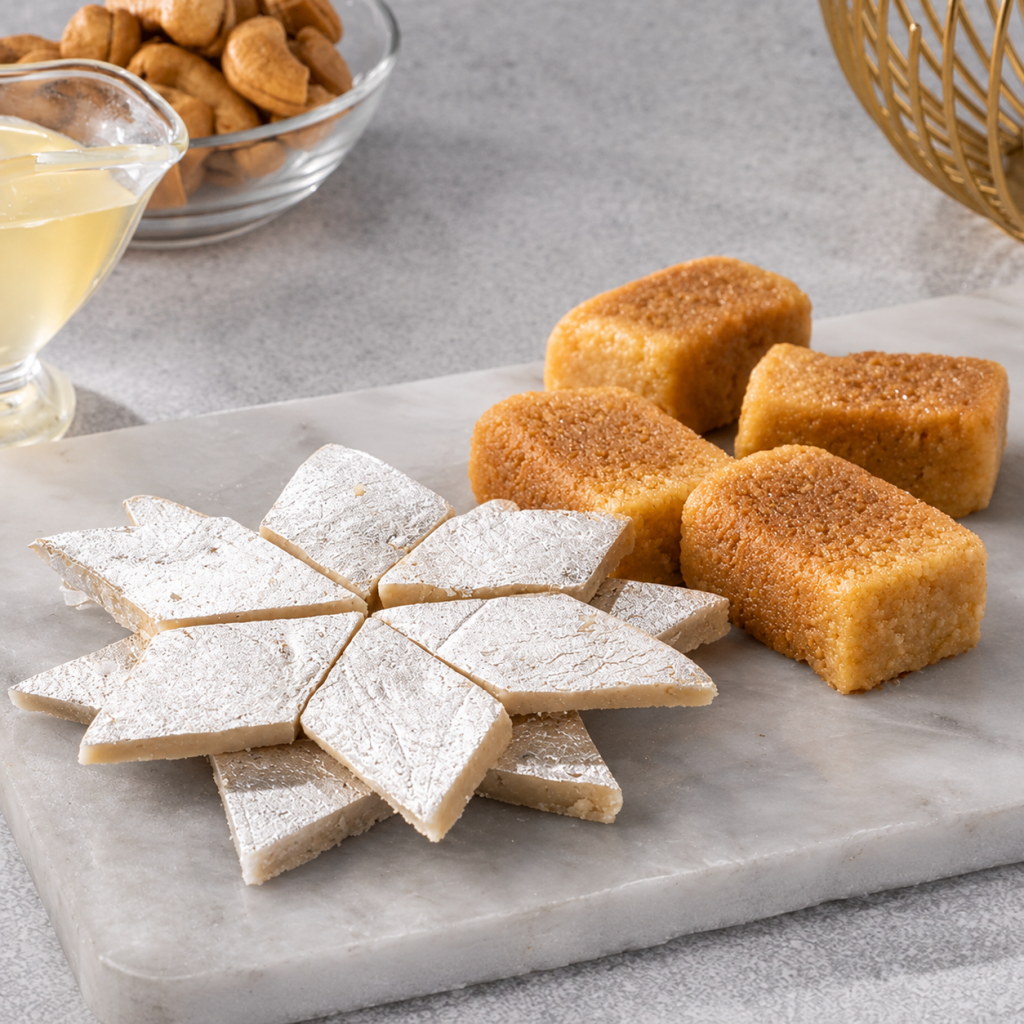
Stand at a mithai counter and half the tray looks the same — pale, soft, cut into diamonds or rounds. Most people point at whatever they recognise and move on.
They’re not the same sweet, and the difference isn’t subtle once you know what you’re looking at.
Quick answer: Kaju katli is made from ground cashews, not milk solids — that’s why it’s smooth, pale and slightly firm. Qalaqand is made from khoya cooked until it turns grainy, so it has a crumbly texture. Chum chum and rasmalai are Bengali-style sweets made from chenna (curdled milk) and soaked in syrup or thickened milk, which makes them soft and wet. Kaju katli keeps the longest; the soaked sweets keep the shortest.
Dry, grainy or soaked
Every milk sweet falls into one of three textures, and that’s the easiest way to think about them.
Dry and smooth. Kaju katli is the obvious one. Cashews are ground to a paste with sugar and rolled thin, so there’s no graininess at all. It’s also the one people gift most, because it travels well, doesn’t leak, and looks expensive — which it is, since cashews cost several times what milk does.
Grainy and crumbly. Qalaqand is khoya cooked past the point where it stays smooth. That grain is deliberate. If a qalaqand is perfectly smooth, it hasn’t been cooked long enough.
Soft and soaked. Chum chum and rasmalai both start as chenna, which is milk curdled and drained. Chum chum is soaked in sugar syrup; rasmalai sits in sweetened, thickened milk. Both are served cold and both need to be eaten within a day or two.
Which one to buy
If you’re gifting, kaju katli. It survives a car journey, it doesn’t need refrigeration for a short trip, and it reads as a premium gift without anyone needing to ask the price.
If it’s for the house, qalaqand. It keeps longer than soaked sweets, it doesn’t need to be served cold, and a small piece is satisfying — which matters when a box has to last.
If guests are coming tonight, rasmalai or chum chum. Served chilled, they close a meal better than anything dry.
If you want something between the two, rabri is thicker and richer than rasmalai, and our guide to the best rabri in Karachi goes into it properly.
For dry sweets like soan papdi and pateesa, which work differently again, see our malai khaja, pateesa and soan papdi comparison.
How long each one keeps
Kaju katli holds four to five days at room temperature and up to two weeks refrigerated, which is the longest of the group. Qalaqand manages two to three days out, about a week in the fridge. Chum chum and rasmalai are same-day sweets — two to three days refrigerated at the outside, and they need to go in the fridge rather than sit on the counter.
Soaked sweets are the ones people get wrong. They’re bought in the morning, left on the counter, and by evening they’ve turned. If it sits in liquid, it goes in the fridge.
How much to order
For a family of four to six, half a kilo of one variety is enough for a few days. For guests, a kilo of mixed is better than two kilos of one — people eat more when there’s choice, and nobody finishes a kilo of the same thing.
For larger occasions, a gift basket or a pre-order box works out better than loose weight, because the packaging holds up and the mix is already balanced.
Frequently asked questions
Is kaju katli made from milk?
No. It’s made from ground cashews and sugar, which is why it’s smooth rather than grainy and why it costs more than khoya-based sweets.
What is qalaqand made of?
Khoya — milk cooked down until the water is gone — cooked further until it develops a grainy texture.
What’s the difference between chum chum and rasmalai?
Both are made from chenna. Chum chum is soaked in sugar syrup; rasmalai sits in sweetened thickened milk and is served cold in it.
Which milk sweet lasts the longest?
Kaju katli. Four to five days at room temperature, up to two weeks refrigerated.
Which sweet is best for gifting?
Kaju katli, because it travels without leaking and holds its shape.