
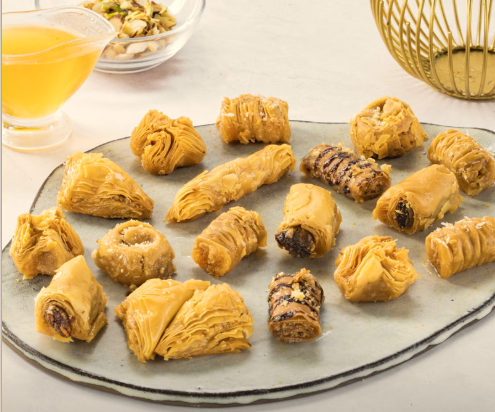
Quick answer: Baklava is a pastry made from paper-thin layers of dough, filled with chopped nuts like pistachios or walnuts, baked until crisp, then soaked in sugar syrup. Good baklava should crackle when you bite it, taste of nuts rather than just sugar, and never feel soggy. It keeps best in an airtight box at room temperature, not in the fridge.
A few years ago, baklava was something you brought back from a trip to Turkey or the Gulf. Now it sits on dessert tables at Karachi weddings, in Eid gift boxes, and next to the gulab jamun at dinner parties.
But with so many versions around, it helps to know what you’re looking at. Here’s a plain guide to baklava: what it is, the main types, and how to tell a good box from a tired one.
What Is Baklava Made Of?
Baklava is made of three things: thin layers of filo (phyllo) dough brushed with butter or ghee, a filling of chopped nuts, and a sugar syrup poured over it after baking.
The dough is stretched until it’s almost see-through, then stacked sheet by sheet. Nuts go in between the layers, the tray is cut into pieces before it goes into the oven, and it bakes until the top turns deep golden. While it’s still hot, cooled syrup goes over the top and soaks down through every layer.
That contrast is the whole point: crisp, flaky pastry on the outside, nutty and sweet in the middle. The dessert is most closely linked with Turkey and the wider Middle East, where it has been made for centuries.
Is It Baklava or Baklawa?
Both spellings are correct. “Baklava” is the Turkish spelling, and “baklawa” is closer to how it’s said in Arabic. They’re the same dessert.
In Pakistan you’ll see both on menus and boxes, often in the same shop. If a recipe or shop uses one spelling and your friend uses the other, you’re still talking about the same thing.
What Are the Main Types of Baklava?
Baklava mostly varies by two things: the nut inside and the shape it’s folded into. Pistachio and walnut are the two classic fillings, and squares, diamonds and rolls are the shapes you’ll see most often.
- Classic square or diamond. Flat layered pieces cut from a tray, with a crisp top and a nut layer in the middle. Our Arabic baklava is this style.
- Pistachio baklava. Bright green filling, often with crushed pistachio on top. It’s richer and usually the most expensive, because pistachios are. Try our pista baklava.
- Walnut baklava. A darker brown filling with an earthier taste. This is one of the most traditional versions.
- Rolls or fingers. Long, thin cylinders of dough rolled around nuts, extra crunchy with more pastry in every bite, like our baklava stick roll.
- Bird’s nest. Round coils of shredded dough with nuts in the centre. Very crisp, and pretty on a gift tray.
If you’re buying for a mixed crowd, a mix baklava box is the safest bet. People almost always have a favourite, and a mix lets everyone find theirs.
How Can You Tell if Baklava Is Good?
Good baklava is crisp on top, generous with nuts, and soaked with syrup without being soggy. If it bends instead of breaking, or tastes only of sugar, it’s either old or made with shortcuts.
Four quick checks, whether you’re in a shop or opening a gift box:
- Listen to it. Fresh baklava crackles when you bite or cut it. Silence usually means it’s gone soft.
- Look at the cut side. You should see a thick, clear band of nuts between the layers, not a thin smear.
- Check the bottom. A little syrup shine is normal. A puddle of syrup in the box means it was over-soaked or has been sitting too long.
- Taste beyond the sugar. Good baklava tastes of butter and toasted nuts first, sweetness second.
This is also why the price of baklava varies so much. Pistachios cost far more than other nuts, and a box that’s cheap usually has less of them.
How Should You Store and Serve Baklava?
Keep baklava in an airtight box at room temperature, away from sunlight and the stove. Don’t refrigerate it, because the cold makes the syrup harden and the pastry go chewy.
If the box has a best-before date, follow that. If a few pieces have softened, five minutes in a warm oven brings back a lot of the crunch. Let them cool before serving.
When it comes to serving, baklava is rich, so small pieces go a long way. A few ideas that work well at home:
- With tea or qahwa. Plain black tea or green tea cuts through the sweetness better than sugary chai.
- On a mixed dessert tray. It sits nicely next to mithai at Eid, weddings and dawats, and gives guests something different.
- As a gift. A neat box of assorted baklava travels well and doesn’t need the fridge. For more ideas, see our guide to the best mithai gift boxes for weddings and corporate events.
Frequently Asked Questions
Is baklava Turkish or Arabic?
Both claim it. Baklava is most famously linked with Turkey and the Ottoman kitchen, and it’s also a classic across the Arab world, Greece and the Balkans, each with its own style.
What is the difference between baklava and baklawa?
There’s no difference. They’re two spellings of the same dessert, Turkish and Arabic.
How long does baklava last?
Usually around a week or so in an airtight box at room temperature. Always check the best-before date on the box.
Should baklava be kept in the fridge?
No. The fridge hardens the syrup and makes the pastry chewy. Room temperature is best.
Can you freeze baklava?
Yes, wrapped tightly. Let it thaw at room temperature in its wrapping so it doesn’t go soggy.
Which baklava is best, pistachio or walnut?
It’s a matter of taste. Pistachio is richer and more expensive, while walnut is more traditional and earthy. An assorted box lets you try both.
Finding Good Baklava in Karachi
The best baklava in Karachi isn’t about the fanciest box. It’s about the checks above: crisp layers, plenty of nuts, and syrup that soaks in without drowning it.
Rehmat-e-Shereen makes baklava alongside its traditional mithai in Karachi, so you can pick up a box with your usual order, or send an assorted box as a gift. Have a look at our full baklava range and see which one becomes your favourite.